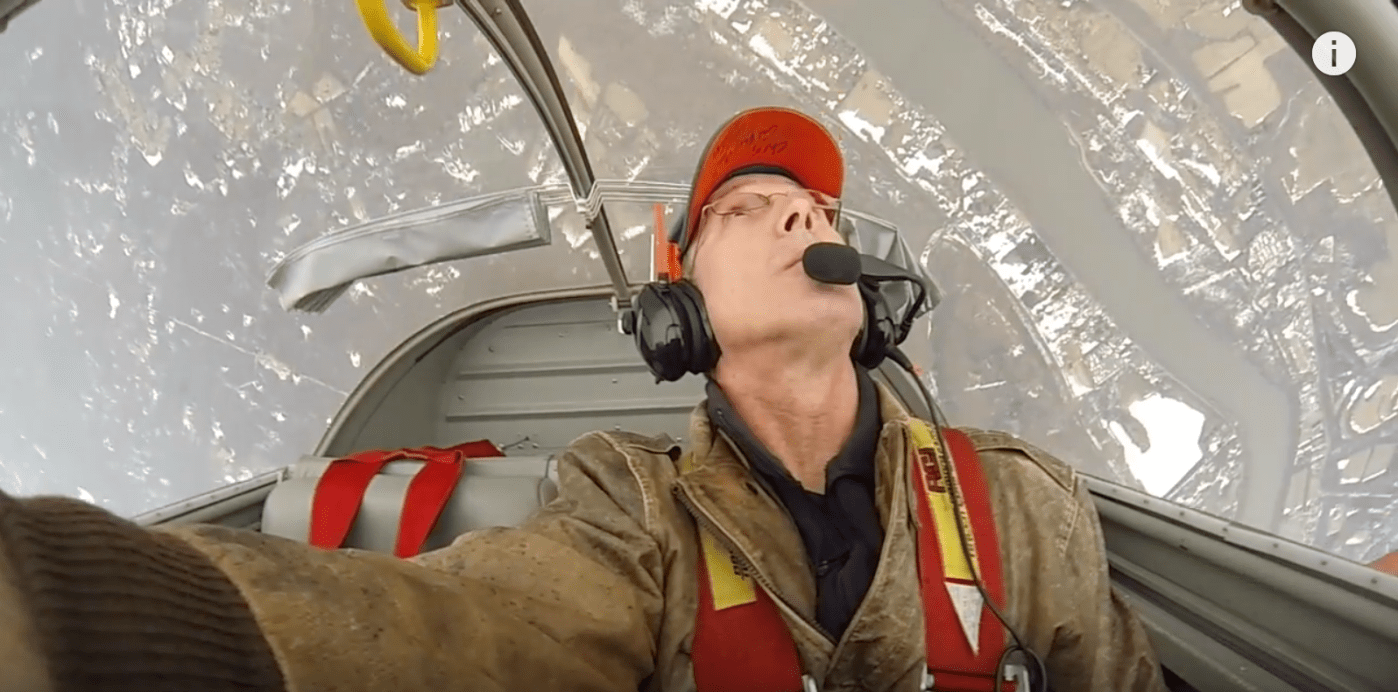
John Mann’s interest in flying began as young as four years old from watching some of his favorite TV shows, including Ripcord, Johnny Quest and Sky King. He dreamed of adventure and was captivated by the thought of flying above the earth looking down at all the sights and special features. He can’t remember a time where he didn’t want to fly, claiming that from his first conscious moment he wanted to be either an astronaut or a pilot flying at high-speed’s in the upper reaches of the atmosphere. As a child he would buy every type of model aircraft he could find. He would build them and fly them around his yard, pressing his cheek against the fuselage pretending he was a military fighter pilot. He could not resist imagining himself flying these aircraft!
A friend of his happened to be a private pilot and invited Mann along on a night flight over the city of Birmingham, Alabama in April of 1977. He loved seeing the city lights and sights out of the window at night. Although he remembers the instruments of the aircraft looking very complicated, he was completely captivated both emotionally and mentally, and was utterly fascinated with the whole sensation. Lucky for him, when he was 20 years old, he was finally able to afford flight lessons. He began as a student pilot training with an instructor working towards his private pilot certificate. This takes about 50 to 70 hours of flight time, but there is also a large amount of time spent in ground school during this entire process as well. The ground training focuses on learning aerodynamics, weather, and cross-country fight planning.
Since his goal was to become a professional pilot, additional training was needed. Some of the requirements included instrument training, commercial maneuvers, and a multi-engine certification. This additional training takes about 150 flight hours and several months of school work. At this point, a pilot in training can become a flight instructor themselves and build more flight time and experience all while training students. Each aircraft is different and transitioning to more complex aircraft requires learning each of the aircraft’s specific details, such as all the different switches, knobs and buttons in the flight deck office. In his opinion, the navigation systems are the most complex component.
To be hired at Continental Airlines in their regional flight department, he had to build up at least 1,500 flight hours. Most of these hours were accumulated as a flight instructor at the Air Force Academy in Colorado Springs. Since 1977, he has logged approximately 24,000 flight hours throughout his career as a pilot, and logs approximately 85 hours per month flying for his job. He is currently ranked as a captain for United Airlines and flies a Boeing 737 aircraft out of Newark, New Jersey. According to Mann,
In the airline industry, you are normally hired out of the regional carriers, military or business jet aviation industry. You may be a captain for the regional airlines; however, as you move up the ladder into a major carrier such as United or Delta Airlines, you start at the bottom as a second officer flight engineer then you moved to first officer or copilot before becoming a captain in the left seat.
John Mann’s first trip was at Continental Xpress regional airline in Denver, Colorado in September of 1989. His team and him flew from Denver’s Stapleton Airport to Casper, Wyoming at approximately 10 AM on a beautiful sunny day. He recalls feeling very nervous since there is a lot to learn in a short period of time. The aircraft was a nineteen-passenger regional turbo prop, a jet engine with propellers, without a flight attendant. Mann himself had to do all the passenger safety announcements.
Every airline pilot has a different schedule, all of which depend on their preferences and relative seniority. The junior new hires have very little control of their schedules whereas the senior pilots have a much better schedule. He explained how each trip is worth 5 to 6 hours of flight time per day. Mann’s typical schedules are one to three day trips each week, and he usually flies 3-4 days on and 2 days off weekly. His preference are 2 day trips, so he will leave on a Tuesday and be home on Wednesday, and then leave again on Thursday morning and be back Friday afternoon. This allows him to have a three-day weekend. They use a computer program to build monthly schedules and with his seniority, he is able to go to cities of his choice.
When he arrives at the airport, special security screenings allow pilots and flight attendants to avoid the long lines at screening locations. They have an expedited process but are sometimes selected to go into the normal screening process which passengers experience. Their profiles are stored in a national database using at least two forms of identification. The flights he pilots generally don’t last more than six hours and flying domestic in the United States does not require breaks in-flight. They will eat meals and stretch her legs periodically throughout the flight. The furthest destinations he has been to is from New York City to Cabo, San Lucas or any city on the west coast along the Pacific Ocean.
Besides actually flying the plane, pilots have many other responsibilities. In order to fly the aircraft proficiently and safely, a pilot must read and study the aircraft manuals and company procedures. Regulations and procedures are very dynamic and change from time to time thus requiring a pilot to spend many hours reading and staying current with the procedures and safety information. In the case of an emergency, pilots must have communication links to medical personnel at all times. If there is an emergency, they will divert the aircraft to accommodate the ill passenger, if necessary. Mann says he has experienced several medical emergencies throughout his career but fortunately, each case ended safely and successfully with the passenger receiving appropriate medical attention, both in the air and on the ground.
The aircraft Mann pilots, the Boeing 737, flies domestically throughout the United States to every major city. They also fly to Central and South America, including Caribbean destinations. He enjoys being able to head out and explore the local sites during an overnight stay. Mann enjoys flying west to the Pacific coast, especially Seattle and San Diego. He enjoys the weather, seeing the sights, and experiencing the culture. His most memorable flights have been when he was able to fly his family to Caribbean locations during overnight stays. He finds it special and rewarding to be able to take his family along with him. If he could, he would love to go to Tel Aviv in Israel and tour the holy city.
When asked what his favorite thing is about flying, he responded with the takeoff and landing phase of the flight. “Taking an aircraft safely off the ground at low altitude and landing is the most exciting portion of flight” [1]. His favorite part of the job is the adventure and the dynamics of flight. He thoroughly enjoys the mission of “planning the flight and flying the plan” [1]. Weather is a constantly changing challenge, but he loves flying airplanes in the clouds and flying instrument approaches where you can’t see the ground until the final seconds before touchdown! When it’s not cloudy, the landscape and environment outside the windows can be seen for miles, and it’s always a beautiful view. Especially the sunsets and sunrises!
Although the schedules can be grueling, especially when flying in the middle of the night, Mann says the toughest part of the job can be the difficult training, but that depends on how well prepared you are for the event. His least favorite part of the job has to be being taken away from home, especially when he needs to be there for his family, friends or community. With his many years of experience as a commercial pilot, his pet peeve are passengers who drink a little too much on their flights. “Drinking in a confined area with a large group of people for long periods of time usually has issues. The troublemakers are usually those who drink too much and have an attitude. They create problems for other passengers and our flight crew” [1].
Mann loves airports out west, and finds the beauty of the terrain in the mountain flying atmosphere satisfying. Some of his favorite locations include Seattle, Phoenix, Boise, Montrose and San Diego. Out of all the airports he has traveled to, there is nothing like his home airport, Queen City. It is located 12 minutes from his house, so he is always able to bring his family and friends, and he enjoys being on a first name basis with the employees.
This airport is where he keeps his personal plane, a red RV6 which he calls “Little Red” that he not only flies for fun but also can do tricks in! He was introduced to aerobatic flying when he first started flying with an instructor, and he loved it. Having an experienced instructor is crucial in order to perform these maneuvers safely. Not only does the training require several hours of practice but getting a feel for the aircraft itself during the maneuvers requires a lot of practice and skill. Flying an aircraft level and straight for a long period of time as a commercial pilot wasn’t exciting enough. Flying acrobatics requires focus, concentration and skill levels he believes are essential for being a safer pilot. Mann loves to master the control of a powerful machine that is eager to do what you command! He can do tricks such as aileron rolls, barrel rolls, and loops, but his favorite trick is the various stages of a pitch and roll. On top of it all, all of these tricks have more complex variations that could be used in competition.
Here’s a link to a video on John’s youtube channel of him doing some tricks.
When asked if he had any other stories he would like to share, he responded with:
Fortunately because of our excellent training, safety-related stories are rare because of the redundancy of our aircraft systems. Any minor glitch is usually resolved thankfully with a flick of a switch. I have seen some amazing sites outside of my window while flying along. One in particular, was falling space debris cascading from the upper atmosphere. What appeared to be directly in front of my Aircraft over Canadian airspace was actually 100 miles away. It looked like a falling house consumed by green flames. Very slow and dramatic!
If you love adventure and the challenges of operating a complex machine, you may want to consider being a commercial pilot as a career for you. Mann believes that there is no other skill set that compares with the dynamics of flight. If you lack a passion for aircraft and flying solo, like being responsible and clearly thinking outside the box, he warns you should probably look elsewhere for career satisfaction. When asked for advice for someone who is afraid of flying, Mann seemed stumped:
That’s a good question, trusting another individual flying you in an aluminum tube at high-speed’s filled with jet fuel in an atmosphere which is hostel for human survival is a daunting concept. I would advise, bring a good book or an iPad and distract yourself with onboard entertainment.
His absolute must-haves when leaving for a trip are workout clothes for the overnight, food and snacks. He absolutely can’t leave home without some good reading material for the layovers. He has never experienced European travel or any destination beyond a six hour flight, so his current bucket list trip is to travel to Australia someday with his wife, Fonda. John Mann’s final tip for travelers near and far is to “enjoy the adventure and the aircraft’s motion. The machines are designed for turbulence and weather. The pilots flying in America are highly trained and skilled professionals. Relax and enjoy the ride…. Sure beats walking!”
 The Road Most (Knowledgeably) Traveled
Leave a comment